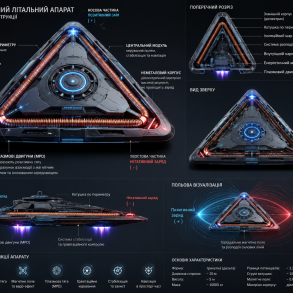
SD Project – Cheap mega aircraft carrier
Author – Sukhachev Denis Pavlovich
This is a work, and the author’s right to a work under international law comes into force from the moment the work is created.
Cargo megaships are vessels that carry huge volumes of cargo, including containers, oil, gas, ore, and bulk materials. They are divided into several main types: container ships, bulk carriers, tankers, and roll-on/roll-off ships.
The main parameters of megaships:
- Payload (DWT – Deadweight Tonnage)
- Supertankers (ULCC) – up to 550,000 tons
- Large container vessels (ULCVs) – up to 240,000 tons
- Bulk carriers (VLOC, VLBC) – up to 400,000 tons
- Dimensions
- Length: 300 to 400+ meters
- Width: 50 to 70 meters
- Depth: 15 to 24 meters
- Deck area
- For container ships (ULCVs) – more than 24,000 m²
- For bulk carriers – depends on the configuration of the holds
- Depth of the hold
- For bulk carriers – up to 30 meters
- For container ships – about 15-20 meters
- Number of containers (TEU – Twenty-foot Equivalent Unit)
- The largest container ships can accommodate 23,000-24,000 TEU
- One 20-foot container has a volume of about 33 m³.
- Speed
- The average speed is 20-25 knots (37-46 km/h)
Yes, mega-cargo ships can be modified for humanitarian purposes by adding an extended deck. Here are some technical aspects to consider:
1. Deck modification
- Perimeter expansion:
- Adding external platforms or pontoons to increase the deck area.
- Use of retractable or folding sections for temporary expansion.
- Construction:
- Metal frame with reinforced supports for even load distribution.
- Use of lightweight, durable materials (aluminum alloys, composite materials).
2. The purpose of the humanitarian mega-ship
- Hospital ship: large open areas for mobile hospitals.
- Logistics platform: fast transshipment of humanitarian goods.
- Rescue ship: equipment for evacuation, autonomous modules.
3. Impact on seaworthiness
- Center of gravity: deck expansion changes stability, so stabilizers are needed.
- Wind resistance: large superstructures can affect the ship’s handling.
- Draft and load capacity: you need to calculate the weight balance to avoid overloading.
4. 4. Alternative solutions
- Use of modular structures that can be quickly assembled/disassembled.
- Integration of inflatable platforms to temporarily increase the area.
If I want to create a modified mega-ship with a solid deck that can accommodate helicopters or even airplanes for humanitarian missions, exploration of Antarctica or other hard-to-reach regions, here are the things to consider:
1. Modification of the ship for a solid deck
✅ The main idea is to create a flat, strong deck that extends beyond the standard ship’s hull.
- The width of the deck can be expanded by means of steel protrusions or pontoons to distribute the load.
- The length of the deck remains within the ship’s limits (300-400 m), but can be increased by bow and stern modules.
- The coating material is reinforced steel or composite materials with an anti-icing coating (important for Antarctica).
- Lifts and hangars below deck for aircraft maintenance.
2. Deployment of airplanes and helicopters
The capacity estimate is based on the dimensions of an average container ship (~400 m long, ~60 m wide):
If helicopters use retractable wings or folding blades, the capacity can be increased to 100 aircraft.
3. Additional features for Antarctica
- Ice-resistant housing for operation in icy waters.
- Deck heating to prevent icing.
- A system of hangars below deck to protect aircraft from harsh conditions.
- An autonomous power system is a nuclear or hybrid engine.
- An ice-cutting nose module for passing through ice fields.
4. 4. Analogs and concepts
These ships are partly reminiscent of:
- Aircraft carriers (but without combat functions).
- Modular mobile bases for transportation of equipment and construction of stationary stations.
- Ice-class container ships that can be modified.