Author: Denis Pavlovich Sukhachev
This is a work, and the author’s right to a work is protected by international law. The author’s ownership of a work begins from the moment the work is created.
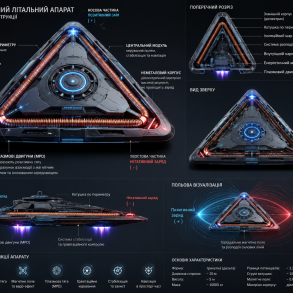
SD-380 airplane concept
The addition of a seventh engine and winglets creates a completely new configuration with unique characteristics. Let’s take a look at how these changes affect the airplane.
The seventh engine is located on the center axis in the lower part of the tail section. This arrangement provides several important advantages:
1. Balancing the traction:
The center engine acts as a balancing element to help distribute thrust evenly. If any of the side engines fail, the center engine helps maintain symmetry of thrust, which is critical for flight safety.
2. Additional power:
The total thrust has now increased to 3500 kN, which allows:
– Improve takeoff performance
– Increase the maximum takeoff weight
– Provide additional power reserve for emergency situations
The wingtips are an extremely important addition that significantly changes the characteristics of the aircraft. Vertical stabilizers at the wingtips perform several functions at once:
1. Aerodynamic efficiency:
– Reduce the inductive resistance of the wing
– They work like aerodynamic winglets
– Improves wing flow at high angles of attack
2. Stability and controllability:
– Significantly improves road stability
– Provide additional control in case of side wind
– Increase the efficiency of ailerons
3. Structural advantages:
– Reduce the load on the wing structure
– Dampen vibrations of the wingtips
– Increase structural rigidity
In combination with the central stabilizers, the edge plumage creates a comprehensive stability system that allows:
– Confidently control the aircraft in all flight modes
– Reduce the load on the automatic control system
– Improve performance in turbulence
– Ensure stability in case of engine failure
This configuration brings the handling characteristics of the flying wing closer to the classical scheme, while maintaining the advantages in payload and aerodynamic efficiency.
The airplane is becoming more versatile and can effectively perform various types of transportation operations:
– Transportation of super heavy cargo
– Flying at maximum range

– Operating from short runways
– Operation in difficult weather conditions
Let’s take a closer look at the evolution of the aircraft and the key differences between the versions:
The final version with seven engines and integrated winglets demonstrates the best performance in all respects. Thanks to the balanced distribution of thrust and additional vertical winglets at the wingtips, excellent handling was achieved while maintaining the payload. Improvements in turbulence and crosswind resistance are particularly noticeable.
Compared to the AN-225 Mriya, our final version has significant advantages:
– Cargo capacity increased by 130 tons
– The flight range is more than twice as long
– Total engine thrust is 2.5 times higher
– Significantly better stability in difficult weather conditions
Each modification added its own advantages:
1. The four-engine version has set the basic parameters of the carrying capacity
2. The six-engine version has improved handling and flight characteristics
3. The final seven-engine version with a full range of plumage provided an optimal balance of all parameters
The most significant improvements are in the areas of handling and performance. The addition of the winglets and the central engine made it possible to:
– Reduce the length of the run by 700 meters
– Increase resistance to side wind by 7 m/s
– Improve maneuverability while maintaining stability
– Reduce the time to prepare for departure