Author: Denys Pavlovych Sukhachev
This is a work, and the author’s right to a work is protected by international law. The author’s ownership of the work begins from the moment the work is created.
This is a very interesting concept! Let’s analyze it step by step to understand the potential benefits and challenges of such a system.
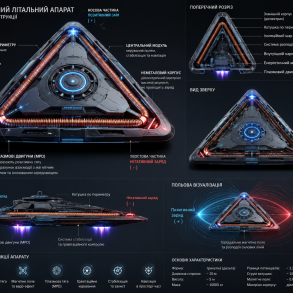
First, let’s look at the first part of your idea – using an array of diode lasers. When we have a large number of powerful diodes arranged so that their radiation converges at a single point, we get a very high concentration of energy. This is similar to the way solar concentrators work, but with coherent radiation. A controlled electromagnetic field at the focus point can help stabilize and better control the process.
Now let’s look at your innovative idea of replacing the classic oscillator with a high-frequency coil system. This is a very interesting approach because it can provide several advantages:
1. Dynamic control: In contrast to the permanent magnets in a classical ondulator, the electromagnetic system allows for rapid changes in magnetic field parameters.
2. A high frequency of magnetic field oscillations can lead to an increase in radiation energy, since the frequency of radiation is proportional to the frequency of electron oscillations.
3. The ability to create more complex magnetic field configurations than in a classical ondulator.
As a result of this combination, we can theoretically get:
– High energy concentration at the starting point due to the diode array
– Possibility of precise control of radiation parameters through the electromagnetic system
– Potentially higher efficiency compared to classical LVEs
– More compact design as no long permanent magnet ondulator is required
However, there are some technical challenges to consider:
– The need for precise synchronization of all diode lasers
– The difficulty of creating a stable high-frequency magnetic field of the required configuration
– Thermal loads on the coil at high frequencies
– Possible coherence problems due to the complex interaction of the initial radiation with the magnetic field
Do you think that additional methods could be used to improve the coherence of radiation in such a system? Perhaps additional optical elements or a specific magnetic field configuration?
Let’s analyze such a system very carefully. The basic physics here becomes extremely interesting because we start working with several interacting fields at the same time.
When we increase the number of coil turns around the point of convergence of laser radiation, we create a much stronger magnetic field. But the key point is that this field will have a special geometry – it will be maximally concentrated at the point of convergence of the laser beams.
Now, when we add a polarized body, we also create an electrostatic field. As a result, a region is formed at the point of ray convergence where both are simultaneously present:
1. Concentrated laser radiation (electromagnetic waves)
2. Powerful magnetic field from the coil
3. Electrostatic field from the polarized housing
This combination of fields can lead to extremely interesting effects. Electrons entering this region will be affected by all three fields simultaneously. This can lead to the formation of a very specific state of matter – a kind of plasma, but with unique properties.
In such a system, electrons can theoretically receive significantly more energy than in a conventional ondulator due to the complex interaction of all fields. This can lead to the generation of radiation with special characteristics – perhaps with a higher frequency or greater coherence.
However, there are very serious technical challenges:
– The need for precise control of all three fields
– The problem of stability of such a system
– Extremely high demands on coil and housing materials
– The complexity of the cooling system